Call the Cat — devlog
TL;DR: I thought the store listing was the finish line. It was the start line — so I built a second mode on top of the game I’d already shipped, instead of starting a new project.
On release day I honestly thought a chapter was closing. I expected development to flip to “complete” the moment it hit the stores. It did not.
Things you can only learn after it’s listed
There are things you cannot know until the game is on a store. Where people stop. What they came in expecting, and what wasn’t there when they left. Things you could only imagine during development come back as behaviour and reactions.
What came out of that was a second mode: Call the Cat: Dream.
It’s a new mode, not a new game
Worth being precise: this doesn’t replace Call The Cat. It’s a second play mode added inside the existing game.
That distinction matters because for a solo developer the two carry completely different weight.
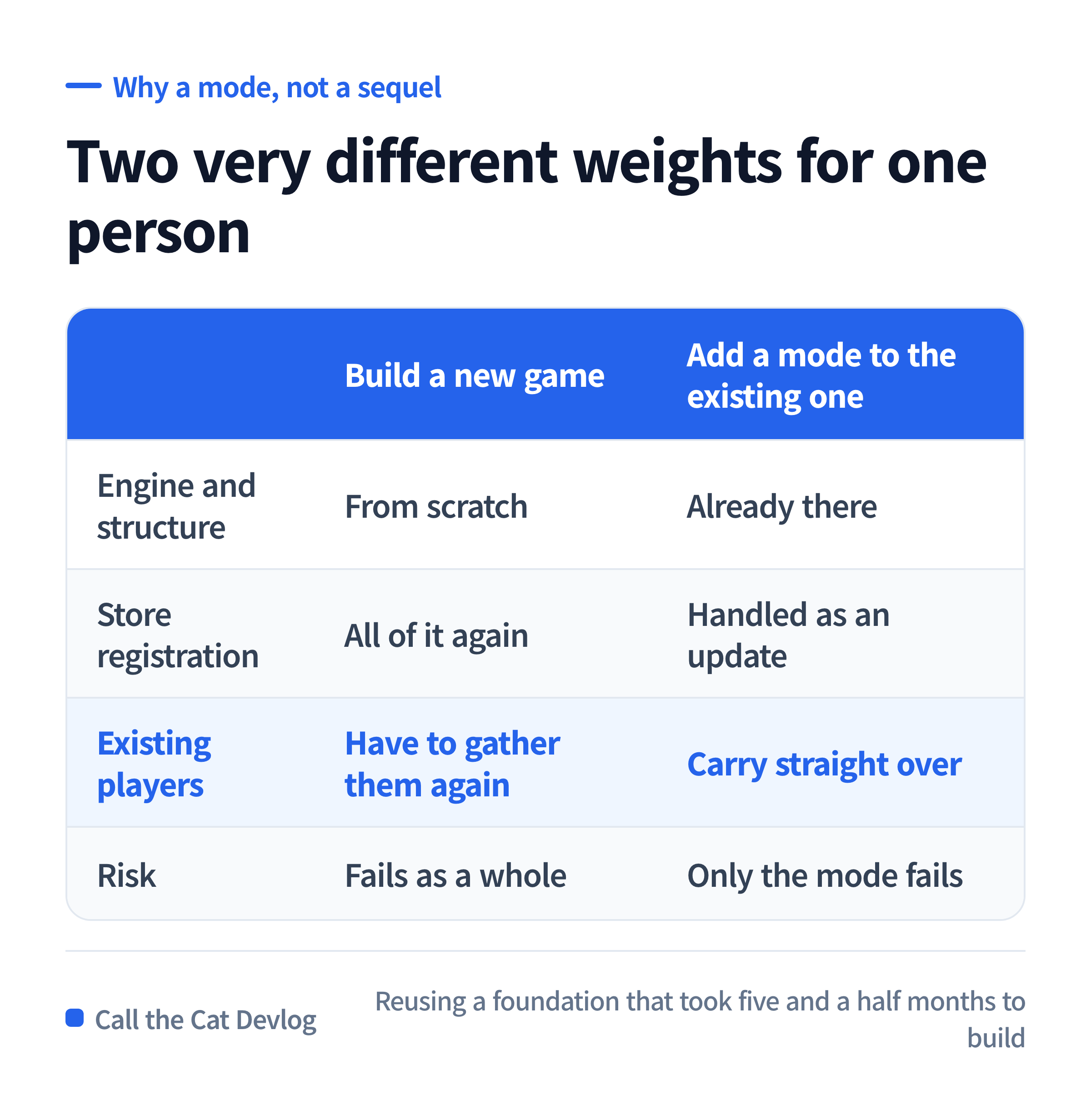
Building a new game versus adding a mode to the one already running.
Building alone, putting something on top of what already runs is far more realistic than starting a new project. It reuses the foundation that took five and a half months to build.
Why a roguelike mode specifically
The original Call The Cat follows a set flow. Once you’ve seen it through, there isn’t much reason to open it again.
Layering a roguelike-style repeat-play structure changes that. There’s a reason to launch the same game again, and play time grows without drawing infinite new content. For someone building alone, “make less, keep it played longer” is the structure that works in your favour.
The platforms didn’t update at the same time
Here’s where a practical constraint of solo development shows up. Updates do not go out to every platform at once. Steam got it through Early Access, Android shipped, and Apple was still pre-patch at the time of the source video.
The three have different review cycles and procedures. For the initial release I could line the dates up; once you’re pushing updates continuously, synchronising three stores every time is not easy. Adding platforms doesn’t triple the release — it triples the maintenance afterwards. That’s the point where I felt it.
How the way I work changed after launch
Before release the goal was “finish.” After release the goal became “add without breaking.”
When people are already playing, breaking their save data or the existing mode while adding a feature is a bigger problem than the feature is a win. So from that point on I write down what must not be touched first, limit each change to one thing at a time, and re-check the existing mode after every change.
It’s slower. There’s less to undo.
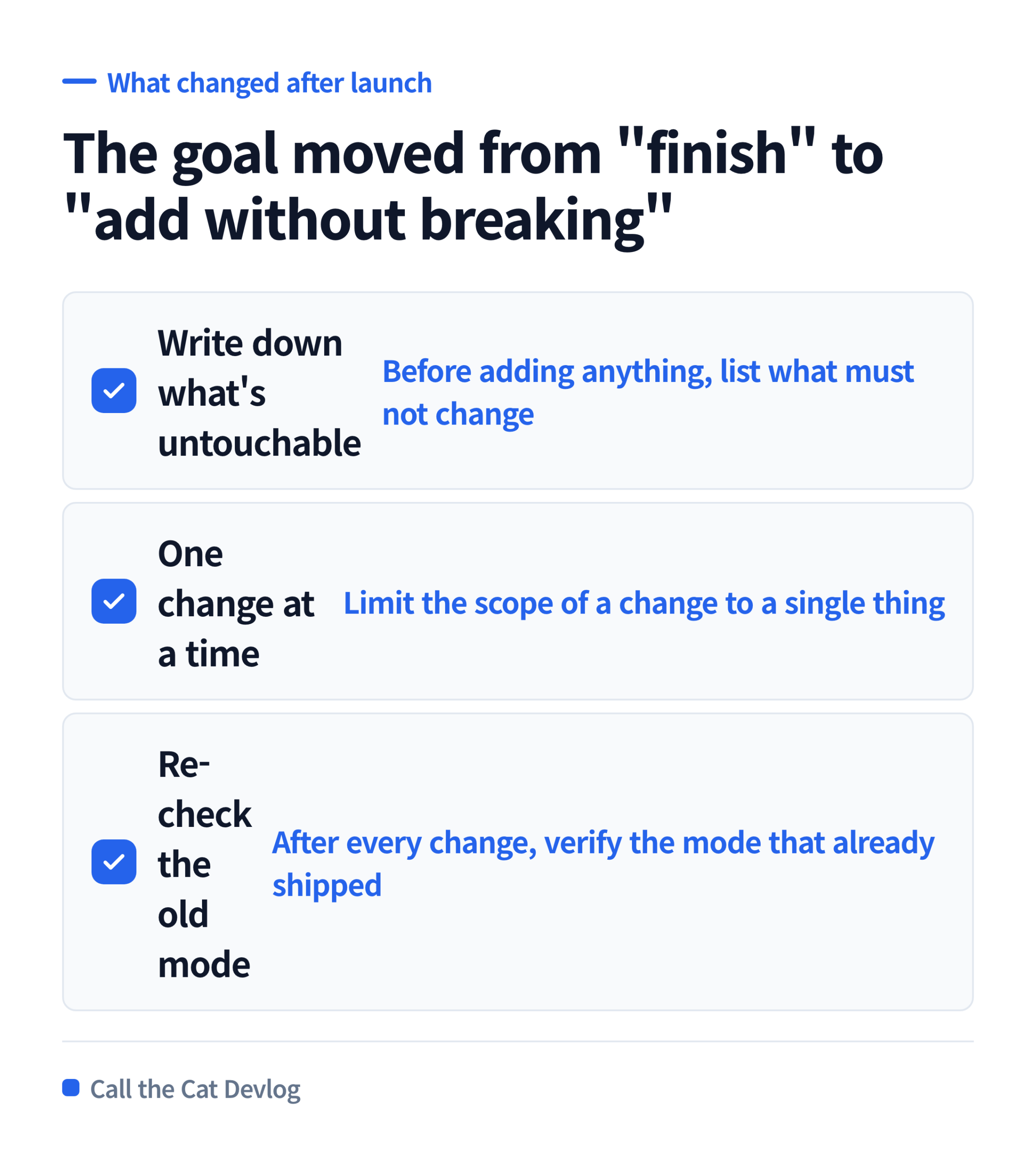
What changed in the working method once real players were on the build.
Where this leaves things
Day 201. Shipped, second mode added, still going. The original goal — “release” — is behind me and it still isn’t over. I now think that’s normal rather than strange.
Solo dev of Call the Cat, shipped after 178 days
on Google Play
and Steam.
The sequel, Call the Cat: Galaxy, is now on the App Store — still building it in public.
Leave a Reply