Solo game development — verification notes
TL;DR: A contact address alone did not tell players what to include. I organized six FAQ paths and generated a mail draft without pretending that the page sends mail automatically.
A support page needs a route, not just an address
I used to think a support page was complete when it showed one contact address. With several games, that leaves players wondering whether a purchase problem, a save problem, or a privacy question belongs in the same message.
The support hub groups the questions before it asks for details. It also shows each game’s icon and release state in one place. The work was prepared as a page draft; the draft itself is not evidence that a public site has been updated.
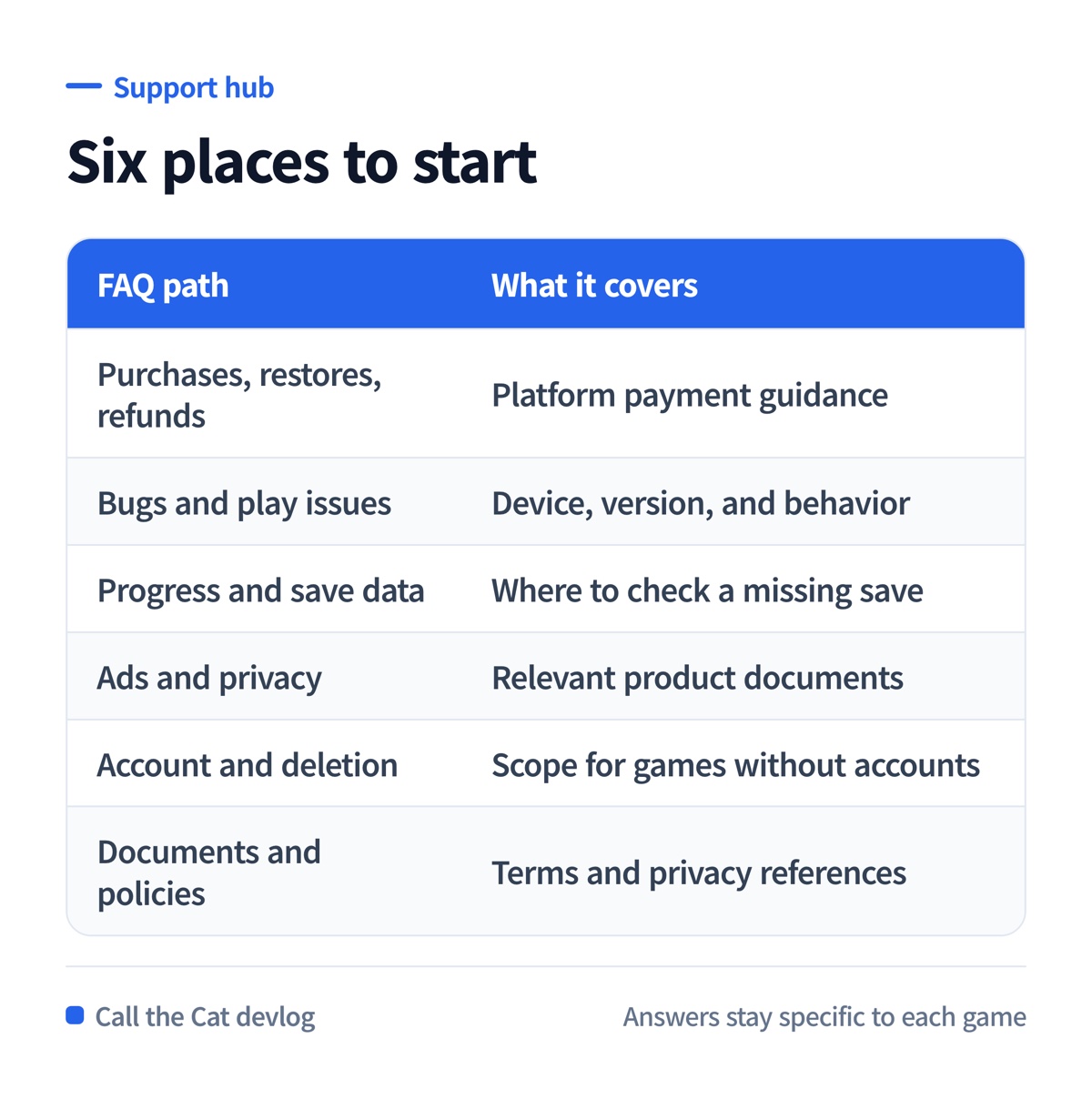
Six FAQ paths give a player a starting point before writing a support request.
| FAQ path | What it covers |
|---|---|
| Purchases, restores, and refunds | Platform guidance for payment questions |
| Bugs and play issues | Device, app version, and observed behavior |
| Progress and save data | Where to check a missing or changed save |
| Ads and privacy | Links to the relevant product documents |
| Account and deletion requests | The actual scope for games without accounts |
| Documents and policies | Terms and privacy policy references |
The answers stay game-specific. I did not copy payment, advertising, or cloud-save behavior from one game into another just because the questions looked similar.
The mail draft stops before sending
The form can collect a question type, game, device, app version, and description, then prepare a subject and body for the user’s mail app. It also offers a way to copy the draft when the mail app does not open.
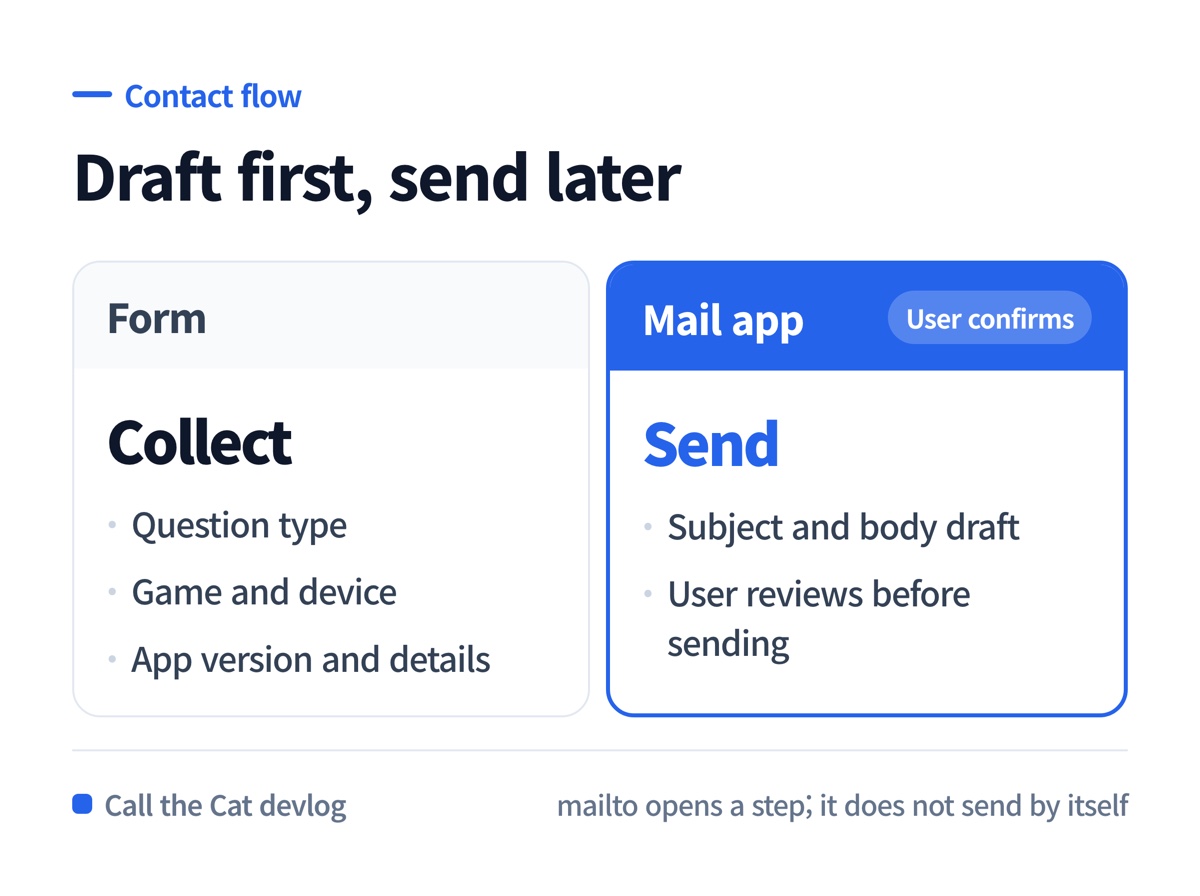
The support form prepares a message for review instead of sending it silently.
That last distinction belongs in the wording. A `mailto:` link opens a mail-handling step; it does not prove that a message was sent. The user still reviews and sends the draft.
The form warns against sensitive data
The page tells players not to enter passwords, verification codes, or card numbers. A useful bug report can still include the device, app version, and reproduction steps. Those details should not be mixed with credentials or full payment data.
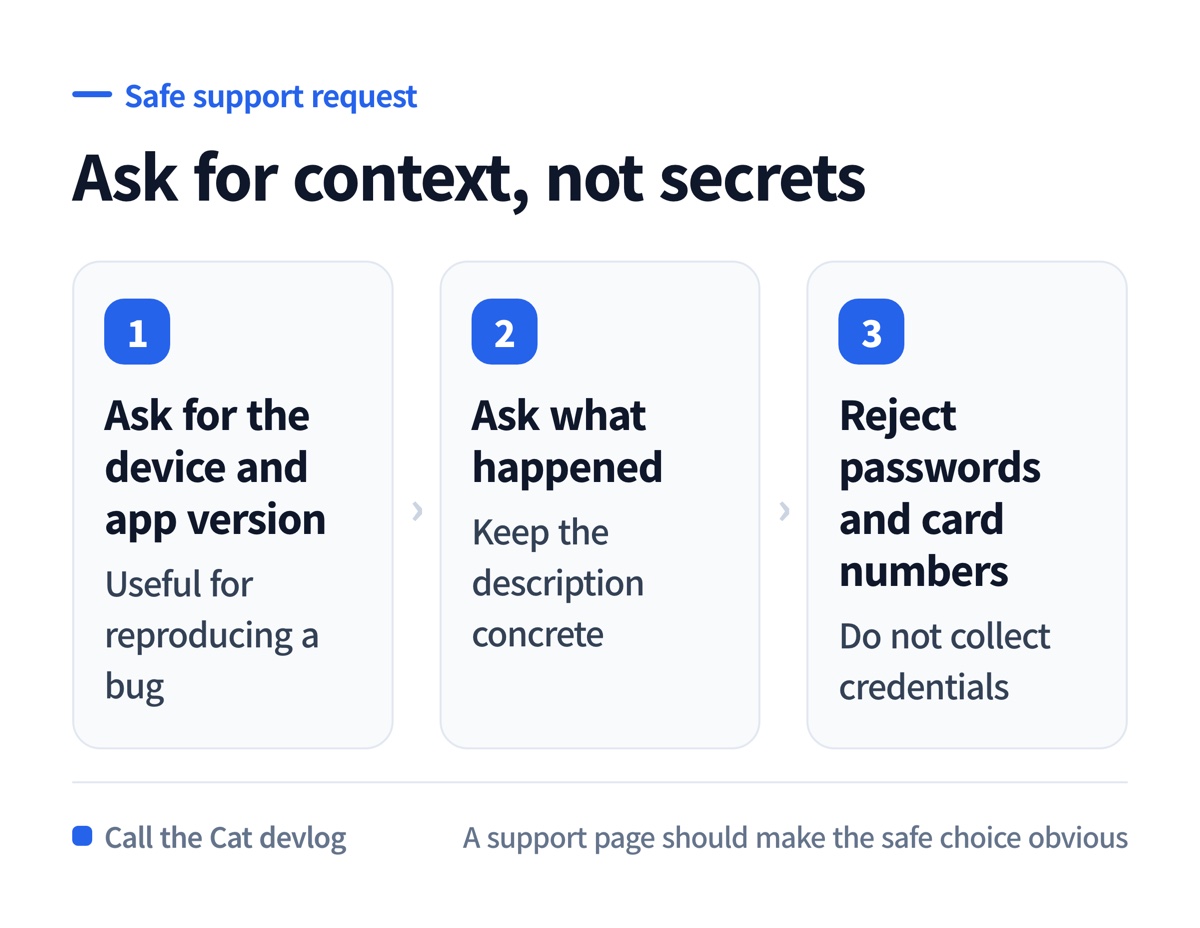
Ask for reproducible context while warning users not to submit credentials or card numbers.
Release labels must follow evidence
The hub also needs careful release wording. On the day of the change, some games were in private testing or review. I used “in preparation” rather than “released” until an actual store address could be opened.
That is a small copy decision with a real consequence: a support page should not promise a download that a player cannot reach.
At a glance
| Item | Evidence-based conclusion |
|---|---|
| Structure | Six game-specific FAQ paths |
| Mail behavior | Draft creation and copying; user sends the message |
| Sensitive data | Passwords, verification codes, and card numbers are excluded |
| Release status | Use “released” only when the store page is reachable |
| Verification boundary | A prepared local page is not proof of live deployment |
Tags
game support, FAQ, mailto, privacy, product documentation, solo development
Leave a Reply