Call the Cat — devlog
TL;DR: Starting the sequel, I wrote down what to leave out before what to add. One run is 1–3 minutes; the goal is 100% conquest and planting a flag. First I want to find out whether the game is fun inside those two sentences.
After shipping a first game, you strangely want to put everything into the next one. A wider map, more characters, progression, a shop, several kinds of minigame.
But in solo development one feature is never one idea. It needs a screen, a save hook, failure handling, a tutorial, and mobile controls checked alongside it. As features pile up the game gets richer and, at the same time, the odds rise that none of them get finished properly.
So for Call the Cat: Galaxy I decided to write “what are we not doing in this version?” before “what should we add?”
One run is one to three minutes
Call the Cat: Galaxy is a game where a cat expedition lands on a small planet and runs a short action mission. Rather than staying on one planet a long time, I wanted a flow of playing briefly, returning to the map, and picking the next planet.
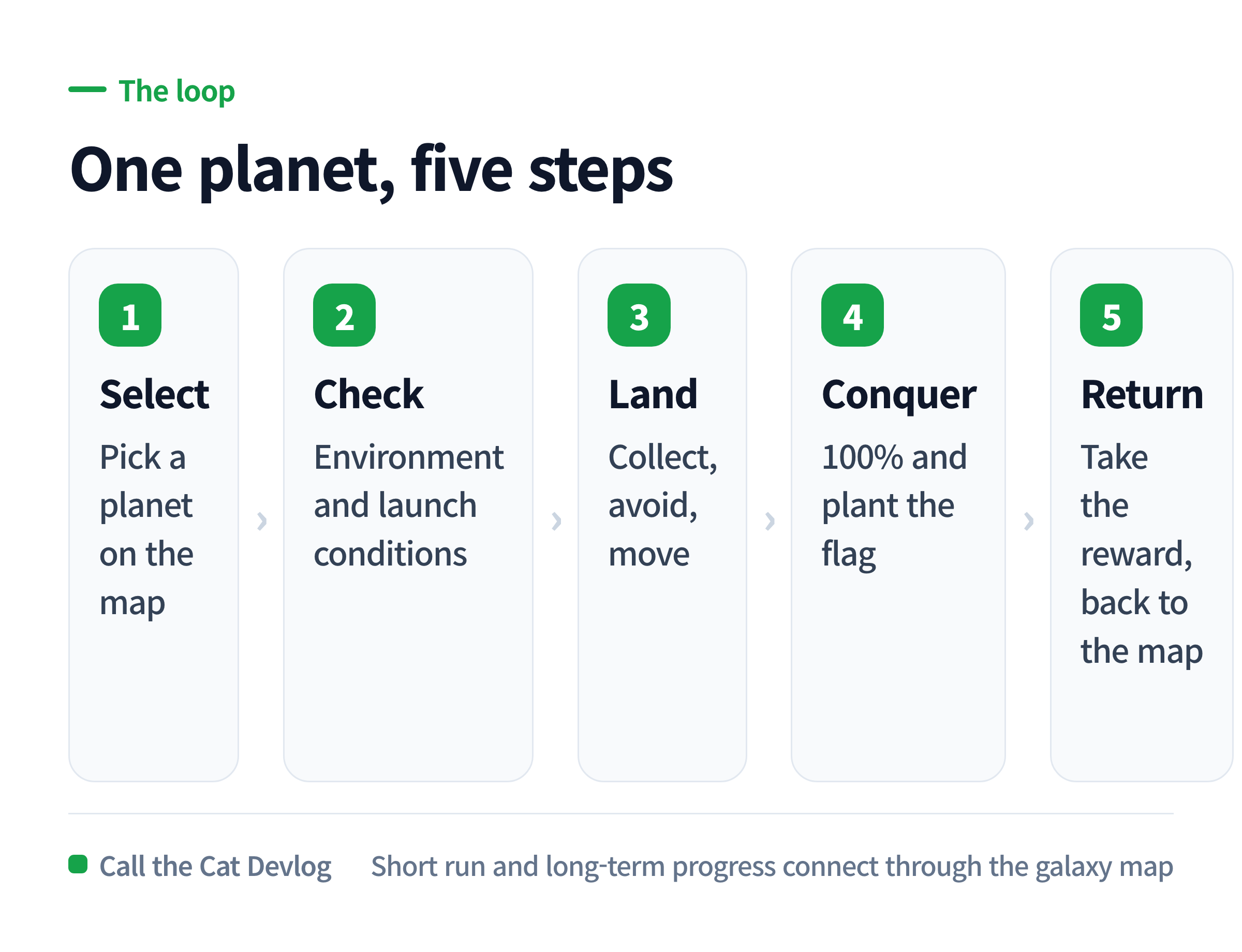
Select a planet, check conditions, land and run the mission, hit 100% and plant the flag, return to the map.
What matters here isn’t that the play time is short. It’s that within that short time the player has to understand what they’re supposed to be doing right now, and feel a real ending when they succeed.
The goal is 100% conquest, not a score
A score-only structure makes it hard to feel you changed anything when a run ends. So the shared goal of this game is 100% planet conquest and planting a flag, not score competition.
The player arrives, adapts to the environment, does the objective, and plants a flag at the end. If that carries through to the cat’s territory visibly growing on the galaxy map, a short run and long-term progress connect naturally.
Whether that goal is actually fun has to be confirmed by playtesting. Right now it’s a core direction set at the planning stage — not a finished play result.
Planets don’t each get their own minigame
Giving every planet its own rules and code looks rich at first. But as planets multiply, so do the places you have to fix. A problem fixed on one planet doesn’t reach the others.
This time the play structure stays shared, and the difference between planets is expressed as environment data. An Earth-type planet uses normal movement and gravity; the Moon has low gravity and long hang time; an ice planet has a slippery surface and different braking.
The input is the same directional control — gravity and friction change what it produces. The player never relearns the controls; they discover different movement from the same input.
If that works, it shrinks the build scope while still making planets feel different. If the difference lands as nothing more than “it got slower,” the design needs another pass.
The spacesuit is an explanation, not a menu
Lulu always wears the base suit. Instead of a menu for swapping gear per planet, environmental equipment deploys automatically. No atmosphere, the helmet seals. Low or zero gravity, thrusters unfold. Extreme cold or heat, heating and cooling become visible.
Two reasons. It removes a gear-swap menu that would break the flow of a run. And it shows the current planet’s rules on screen before explaining them in text.
If a player can look at the suit and predict “movement is going to be different here,” the gear stops being decoration and becomes a signpost for the rules.
What is not in V1
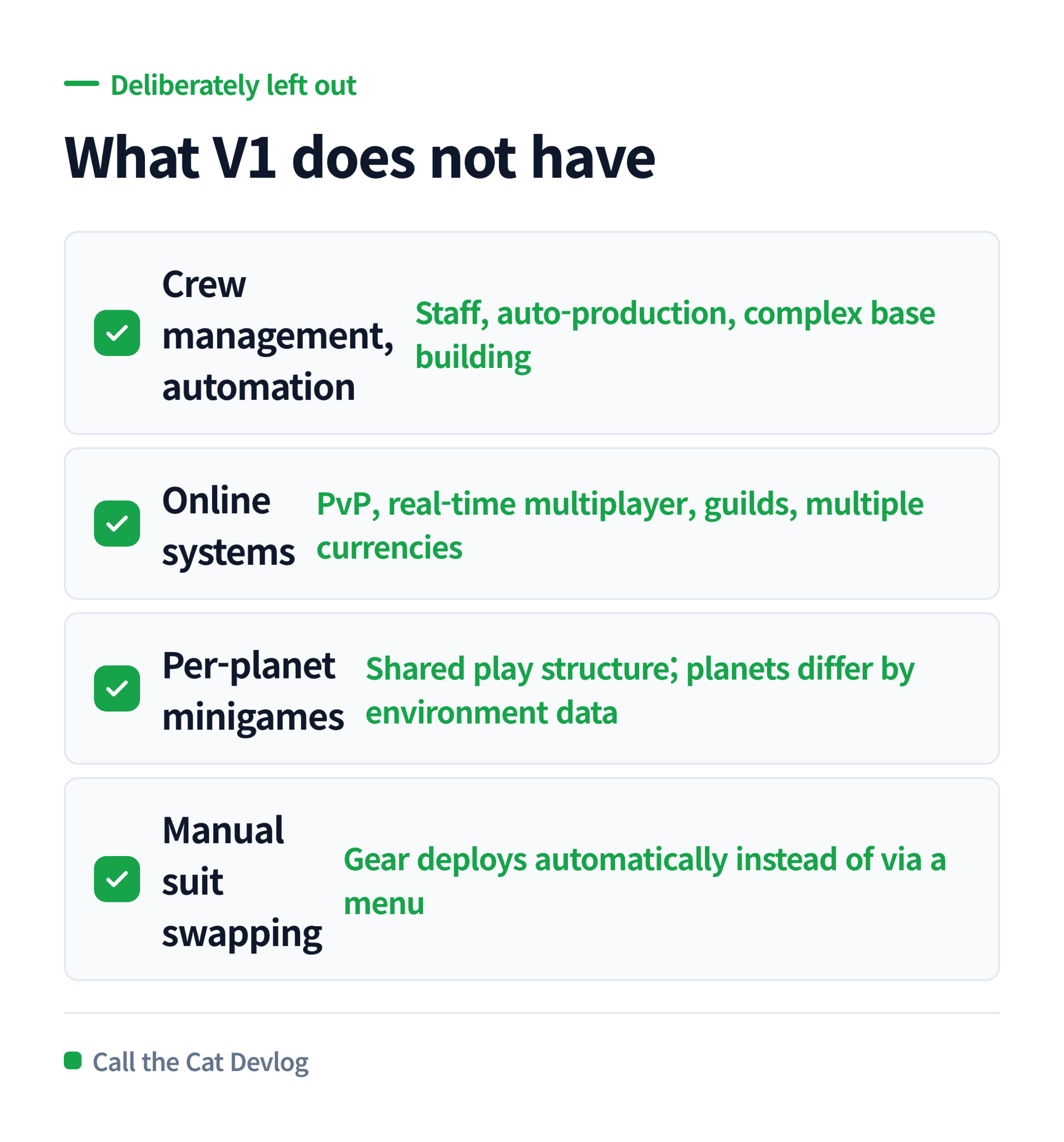
The features deliberately left out of the first version.
None of these are bad features. Putting them in now would blow up the build scope before the core — land, learn the movement, conquer, move on — has been confirmed at all.
What actually needs checking first
Call the Cat: Galaxy is at the stage of having its planning and build criteria written down. The Unity implementation and the vertical-slice playtest are not done.
The criteria for that first check are set in advance: can a first-time player understand the current objective within 30 seconds with no explanation; after alternating Earth-type and Moon, can they describe the difference in movement; can they guess a planet’s environment from the suit deploying alone; does an Earth-type run finish in around 90 seconds; and does the Moon feel like its own thing rather than a slow Earth-type.
If it doesn’t clear those, adding planets and decorating a base waits.
Cutting features wasn’t making the game smaller
What got decided here isn’t a feature list — it’s the centre of the game. A 3D planet space with a 2D character, movement that changes with the environment, a suit that deploys on its own, 100% conquest and a flag. Whether those four connect into one flow comes first.
After that, any new feature has to pass one question: does this make the fun of conquering a planet clearer? If the answer is vague, even a good idea waits for the next version.
There are times in game development when the standard for stopping matters more than the speed of building. For now this is a promise written in a design document. The next record will be whether the design survives contact with an actual first planet loop.
Solo dev of Call the Cat, shipped after 178 days
on Google Play
and Steam.
The sequel, Call the Cat: Galaxy, is now on the App Store — still building it in public.
Leave a Reply