Solo game development — verification notes
TL;DR: The public policy page was current, but the app still showed an old sentence saying it did not request payment or advertising information. The same fact lived in several places, and only one copy had been changed.
The page was fixed. The app was not.
I was bringing the legal text for a delivery game back in line with the shipped build. The public policy page had already been corrected.
Then I opened the policy inside the app. It still said that the app did not request payment or advertising information.
That was the opposite of the actual product. By then it used Google Play billing, ads, Play Games sign-in, and cloud saves.
One fact had been written twice
The public page is HTML. The text rendered inside the app is in a localization file. Updating the public page had changed only the first copy.
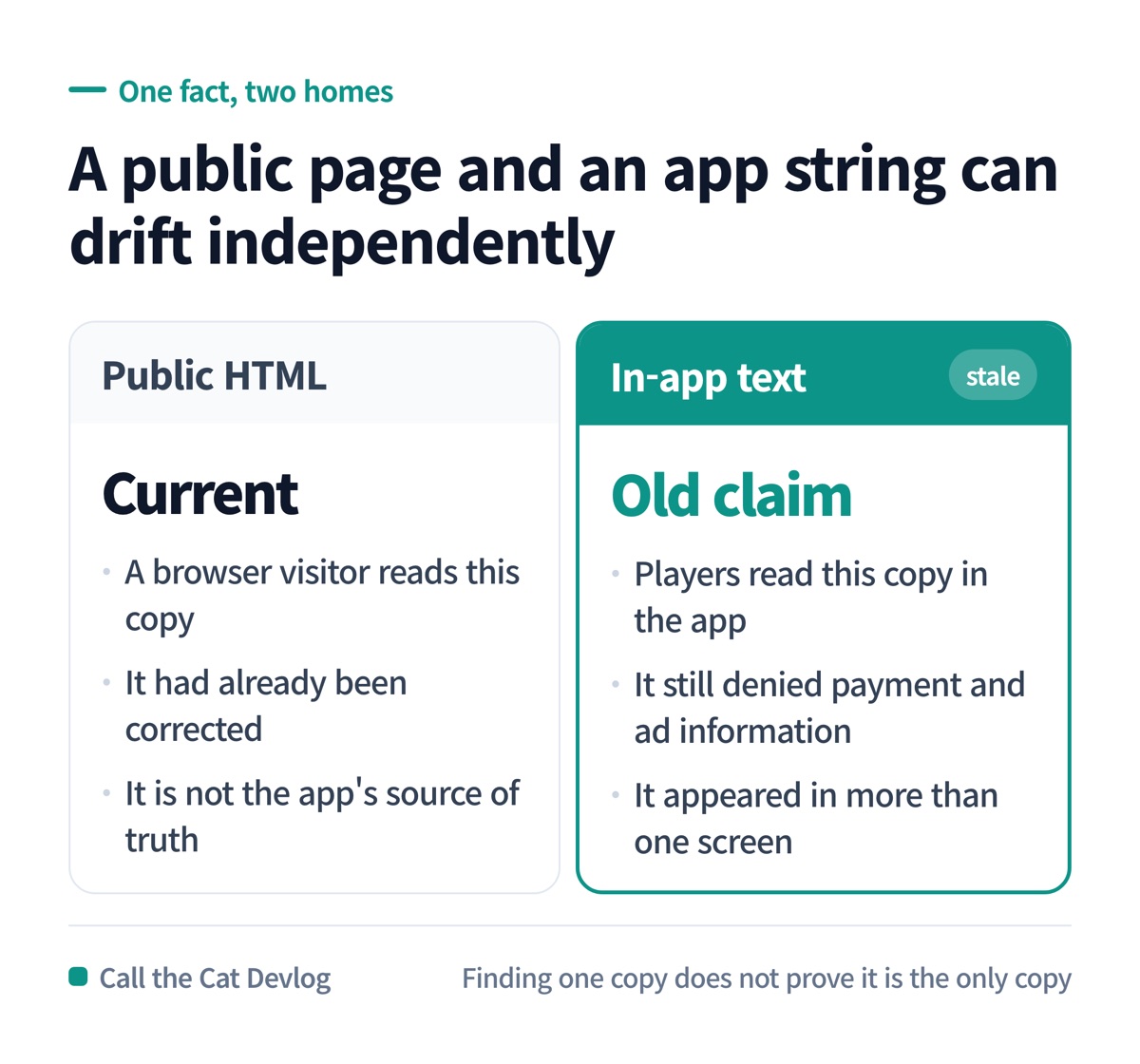
A public web page and an in-app string can describe the same fact independently.
| Place | What it controls | State found that day |
|---|---|---|
| Public HTML page | The policy a visitor opens in a browser | Already corrected |
| In-app localization text | The policy a player reads inside the game | Still contained the draft claim |
The in-app text was also rendered in two places. With Korean and English versions, one stale sentence meant four changes, not one.
The mismatch happened in both directions
The same review found the opposite failure as well. The in-app wording already described Firebase Analytics events and the fact that no personally identifiable information was sent. The public page did not mention Firebase at all.
One side had an old claim. The other side had not received the new information. The direction changed, but the cause was the same: the same fact had more than one home.
A small search prevents a large omission
Before changing policy wording, search the repository for a distinctive part of the sentence. Do that before editing the first match.
grep -rn "part of the sentence to change" . --include="*.ts" --include="*.tsx" --include="*.html" --include="*.json"Every result is not automatically the same user-facing text. But two or more matches mean you need to inspect where each one is rendered before you call the job complete.
Copy this — ask for every copy and every screen
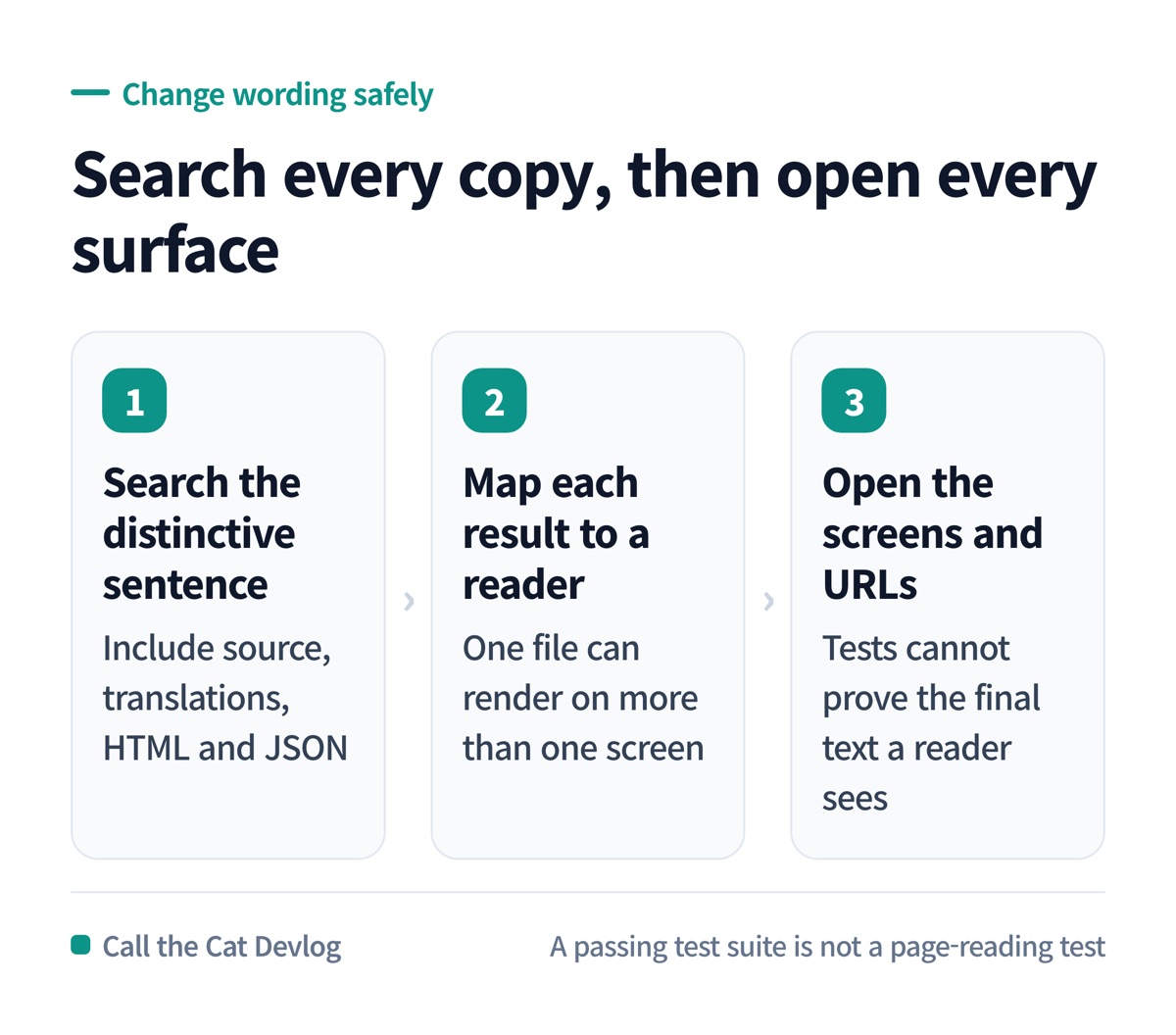
Search for every copy first, then open every place where it is shown.
Give an AI this prompt when you ask it to revise product wording.
Find every file that states this same fact, including translations and public pages.
For each result, say where it is rendered for a user, with file and line references.
After editing, list the screens or URLs that still need to be opened manually.| Question | What it protects against |
|---|---|
| Where is the same fact written? | Updating a public page while an app string stays stale |
| Where is each copy rendered? | Missing two render sites in one file |
| What must be opened? | Treating test success as proof that readers see the new wording |
Tests were not the final proof
The code tests passed, but tests do not tell a reader whether a policy page still exposes a draft sentence. The public page also had stray code-fence markers that were visible in the browser.
That required opening the actual surfaces. Tests can show that the code path is healthy. They cannot replace reading the screen or page a player will see.
At a glance
| Item | Detail |
|---|---|
| Symptom | Public policy current; in-app policy said the opposite |
| Cause | The same fact existed in HTML and localization files, with multiple render sites |
| Related discovery | In-app Analytics detail had no matching public-page section |
| Repair | Updated Korean and English in-app copies and added the missing public information |
| Automated evidence | 171 tests passed after the changes |
| Still required | Opening every in-app and public surface to inspect the words actually shown |
Solo dev of Call the Cat, shipped after 178 days
on Google Play and Steam.
The sequel, Call the Cat: Galaxy, is now on the App Store — still building it in public.
Tags
AI coding, localization, privacy policy, product copy, software testing, solo development
Leave a Reply