Call the Cat — devlog
TL;DR: I had never opened a game engine. The first thing I decided wasn’t “finish the tutorials” — it was “ship it.” Because I had no skill, that was the right call: a finish line is what lets you cut things.
On 2026-01-27 I opened a game engine for the first time. I didn’t know what a variable, a sprite or a room was. And the first thing I decided was not to finish a course — it was to release something. Looking back, having no skill is exactly why that was the right decision.
Finishing tutorials never adds up to a game
I started where everyone starts: courses. And after every single one, the same thought showed up. “If I finish all of these, do I have a game?”
No. A tutorial teaches you one feature. You learn jumping, then collision, then saving. But a game needs those features running at the same time, without breaking each other. Someone who has finished ten tutorials and someone who has finished one game are standing in completely different places.
The more decisive problem is that there is no end to it. There is always more to learn, and the feeling of “I’m not ready yet” never goes away on its own. So the goal had to hang on something that actually terminates — a release.
“Ship it” turns into a decision rule
The moment “release” is the goal, the questions you hit every day start answering themselves.
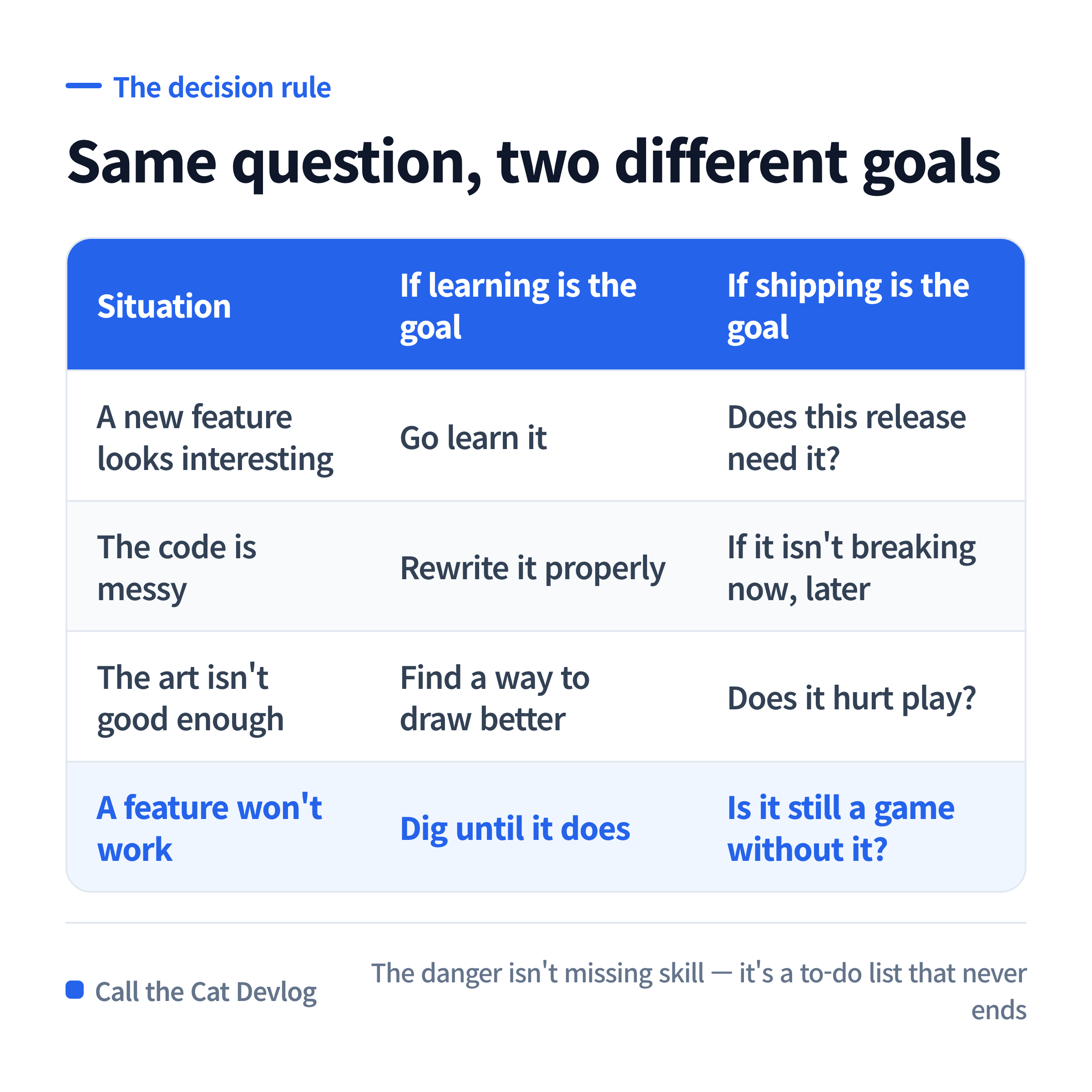
The same four situations, answered by “learning” as the goal versus “shipping” as the goal.
The most dangerous thing for a beginner isn’t a lack of skill. It’s a to-do list that grows forever. With a release line in place you can cut the things that don’t have to happen now. Being able to make that cut at all — that was the real effect of setting the goal this way.
So I aimed small
Aiming at a release didn’t mean building something big. The opposite.
One play flow instead of a vast world. The minimum structure where a character moves, knows its objective, and either succeeds or fails — instead of dozens of systems. A state I could run and check, instead of perfect code.
Every time I built one feature, I ran it immediately. The bar was “I played it,” not “I made it.” I think that’s the reason this actually reached a release.
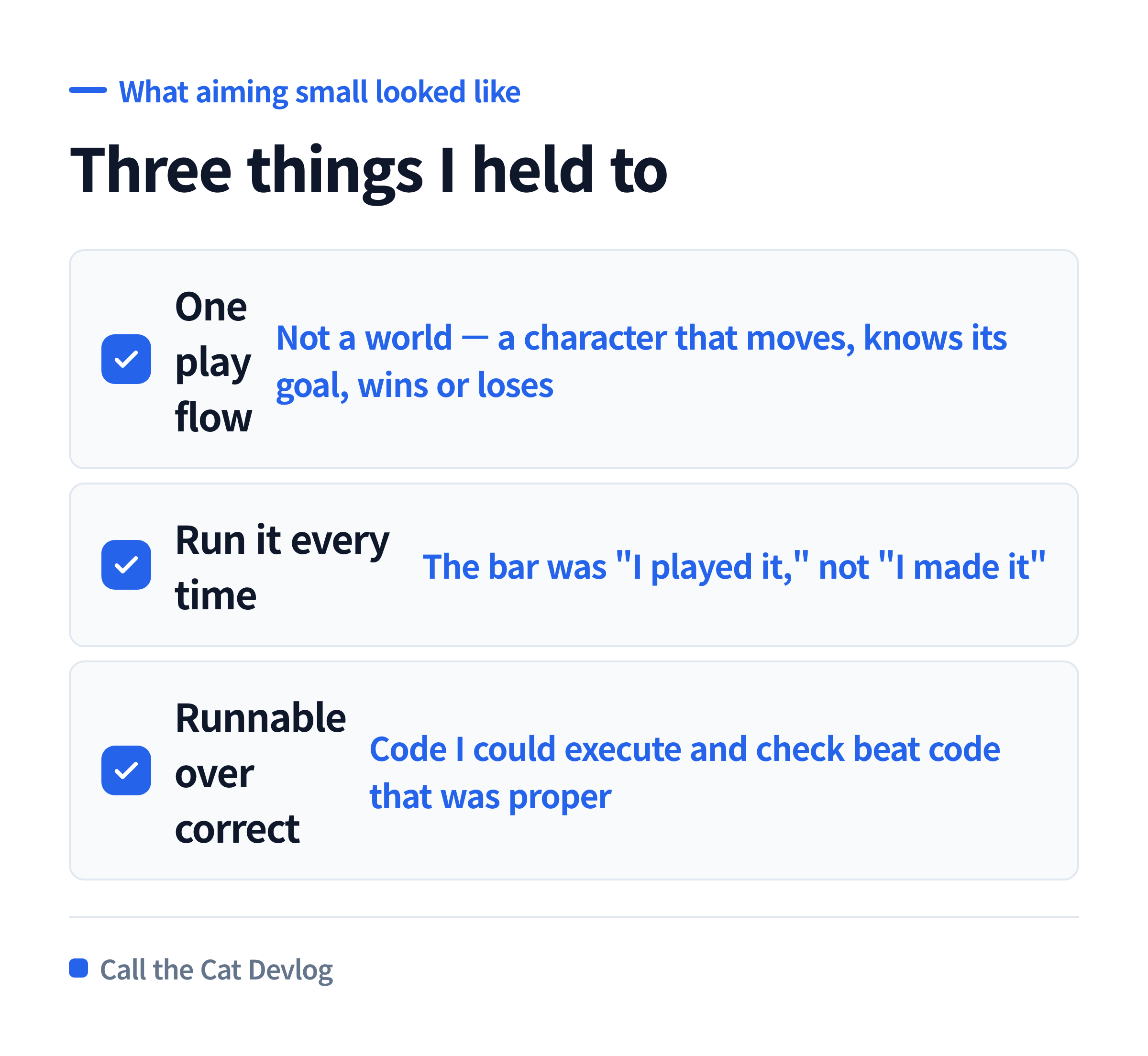
What “aim at shipping” actually looked like day to day.
The AI gave me speed, not direction
GPT genuinely helped. Draft code, searching through a wall, repetitive work — things that would have taken several times longer alone got faster.
But there’s something I learned using it. An AI will build fast, and it will also build the wrong thing fast. If you don’t tell it what state the project is in and what must not change, it hands you an answer that overwrites what you already built. I lost days to that, and that’s its own post.
If you’re starting this
If you’ve just opened a game engine for the first time, I’d set an ending point before setting a learning target. It can be small. What matters is that “this far and I’m done” exists, because that’s what makes cutting possible.
I’ve kept out the numbers I can’t verify — cost, revenue, downloads. What I can say for certain is the date I started, the engine I used, and that 178 days later it was on three stores.
Solo dev of Call the Cat, shipped after 178 days
on Google Play
and Steam.
The sequel, Call the Cat: Galaxy, is now on the App Store — still building it in public.
Leave a Reply