Solo game development — store review notes
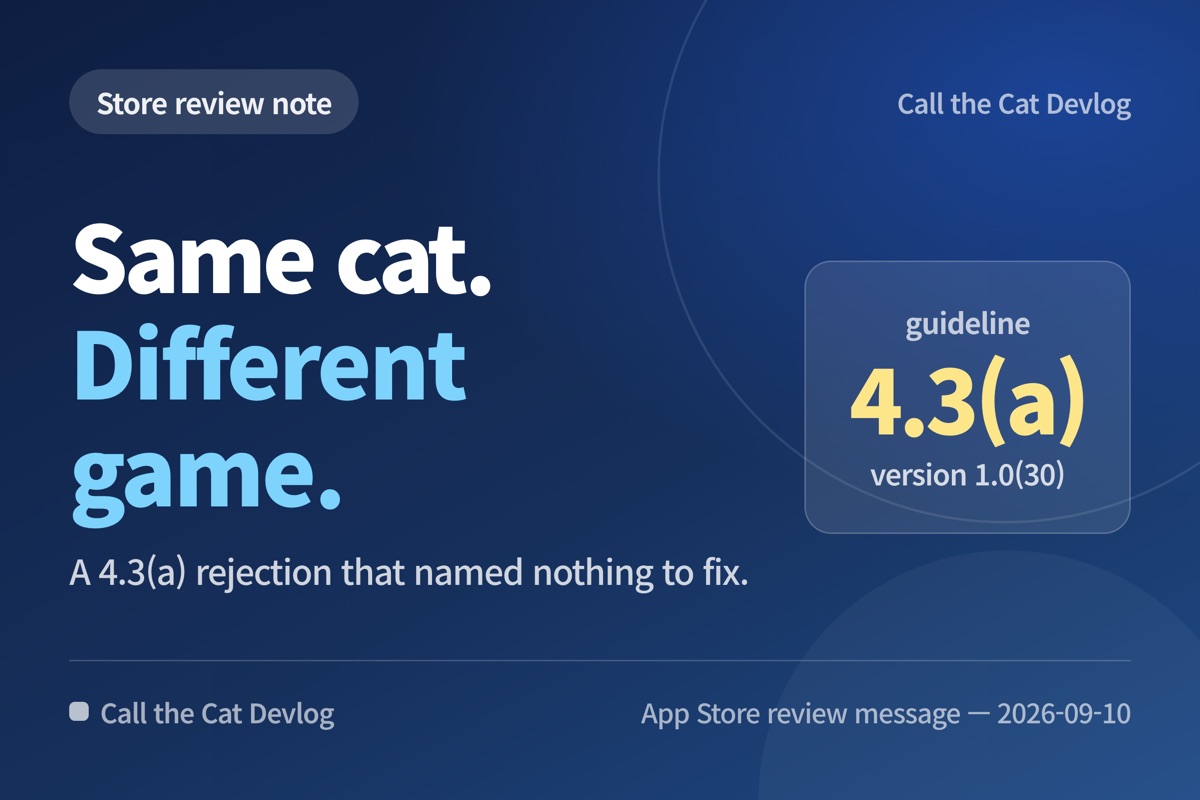
TL;DR: Apple rejected my second game under Guideline 4.3(a). The message named no comparison app and listed no compared features, so I am not guessing at one. What I can do is write down what the two games actually ask a player to do, and ask Apple which elements they meant.
What the message said, and what it did not
I submitted `Call the Cat: Serving!` and received a Guideline 4.3(a) rejection for version 1.0(30) on 10 September 2026. The message said the app shares binary, metadata, or concept with another developer’s app and that the differences appeared small. It did not name the compared app, and it did not list which features were compared.
In Apple’s current guidelines, 4.3(a) describes submitting the same app under multiple Bundle IDs, and 4.3(b) describes apps that are not distinguishable from what is already widely available. Which element this particular message targeted cannot be settled from the text I received. So “it failed because the same cat is in it” and “a different genre guarantees approval” are both conclusions I cannot draw.
The message also did not say “it has a pad,” “it has a jump,” or “it is portrait.” What it did say was broad. So at this stage I am not going to remove a jump or drop a character on the theory that one of them caused this.
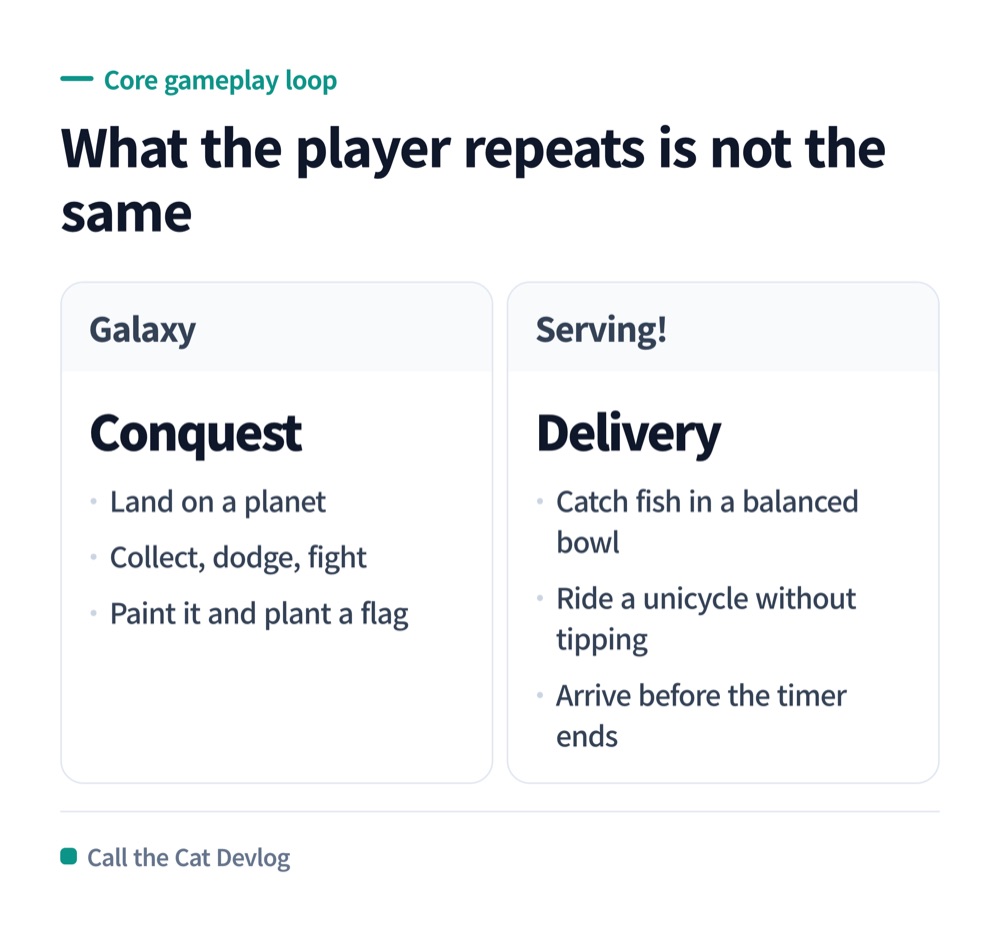
Galaxy is a conquest game. Serving! is a delivery game. That is the difference a review screen has to carry.
Galaxy is about taking a planet
In Galaxy the player rides a ship and lands on a planet. You eat the items a planet asks for while avoiding monsters, paint the surface, and plant a flag once the conditions are met. There is a larger adventure structure across several planets with boss fights. Back at headquarters, a bed leads into a dream world with a roguelite mode built around herding and killing monsters to grow.
Serving! is about not dropping the fish
Serving! is not about conquering a planet or killing anything. Dodo the cat receives more fish than the order requires into a bowl balanced on his head, then rides a unicycle to a destination while keeping that balance. Drop the fish, hit an obstacle, lose balance, or run out of time, and the delivery fails.
I also watched the play recording stored alongside the project. It shows about 69 seconds of receiving fish, riding the unicycle, and heading to a destination. That recording is material for comparing what a player does in each game; it is not evidence of store approval or of finished quality.
The screen shows the difference too. Serving! displays a fish count, a drop count, a time limit, a balance gauge, five fish dispensers, a unicycle control pad, and a jump button. What the player keeps deciding is not “which monster first” but “which way do I correct my balance, and when do I jump to protect the fish.”
The difference, written as a table
| Aspect | Call the Cat: Galaxy | Call the Cat: Serving! |
|---|---|---|
| Core goal | Collect items, paint and conquer a planet | Protect a fish order and deliver it |
| Player actions | Land, collect, dodge, fight, boss battles | Balance, accelerate, jump, carry |
| World structure | Multiple planets, headquarters, dream combat world | Kitchen dispensers and a delivery route |
| Progression | Planet conquest and roguelite growth | Seven stages of rising volume, time, obstacles |
| Failure condition | Monsters, bosses, unmet conquest conditions | Tipping over, dropped fish, obstacles, timeout |
Read only that table and these are different genres wearing the same character. Shared basic movement and jumping is an ordinary mobile control scheme. Reusing the same cat is a choice about keeping a series identity. But that observation alone does not let me say Apple’s decision is wrong. A reviewer can weigh first impression, app name and icon, screenshots, metadata, and shared elements in the actual binary together, and I cannot see that internal comparison.
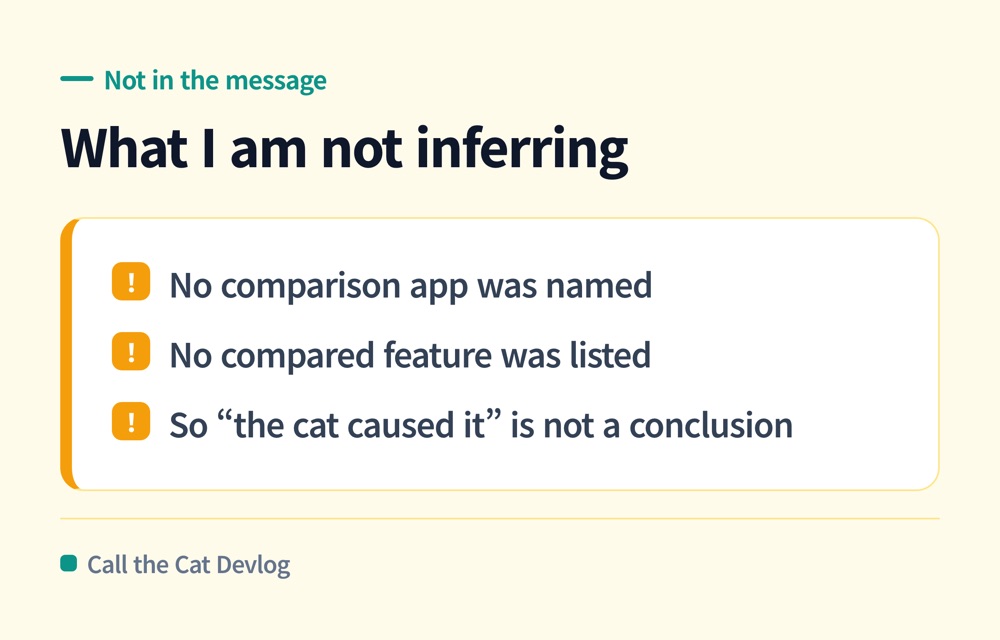
The things the rejection message did not say, kept out of my conclusions.
Where a reviewer could still be confused
Being different and reading as different on a review screen are separate problems. Both apps use the name `Call the Cat` and show the same cat. Portrait orientation, directional controls, a jump, and a cute cat shown together leave room for a reviewer to read the second app as the same series in a new theme within a short look.
So a resubmission note that only lists control differences is not enough. It has to lead with the core loops: Galaxy is planet exploration, collection, combat, and conquest; Serving! is unicycle balance, fish carrying, and timed delivery. It also has to ask Apple which binary, metadata, or concept elements they compared. That request does not guarantee approval. It asks for a standard to fix against.
The note I am sending reads roughly like this:
Call the Cat: Galaxy and Call the Cat: Serving! share a world and character identity, but their core gameplay loops are different. Galaxy is a planet exploration, collection, combat, and conquest game. Serving! is a time-limited delivery game centered on balancing a unicycle while protecting a fish order. Could you please identify the specific binary, metadata, or concept elements that were considered insufficiently differentiated so we can address the exact concern?
At a glance
| Confirmed | Conclusion I am drawing |
|---|---|
| Both apps share the Call the Cat world and some characters | That is series identity |
| Galaxy centers on planet conquest and combat | Exploration and combat game |
| Serving! centers on balancing while delivering fish | Control-focused arcade game |
| Apple named no comparison target or element | Ask for the specific reason first |
What I took from this rejection is that the fix starts with how the difference is presented to a reviewer, not with forcing changes into the game. Reusing the same cat is not something to hide. The work is to show, with actual screens and actual player actions, what new experience was built inside the same world.
Solo dev of Call the Cat, shipped after 178 days
on Google Play and Steam.
The sequel, Call the Cat: Galaxy, is now on the App Store — still building it in public.
Tags
App Store review, guideline 4.3, app rejection, game design, indie games, Unity, mobile games, solo development
Leave a Reply