Galaxy Devlog #05 · Read the Galaxy build log
I do not write code. I cannot read it either.
I am building Call the Cat: Galaxy, the Unity sequel to a game I already shipped, and every line of code in it is written by an AI. My job is to ask for what I want and decide whether the result is actually right. So there is one sentence that scares me more than any bug report.
“Fixed.”
If I could read code, I could open the file myself and see what changed. I can’t. So when that word shows up, I have to decide what to trust it with.
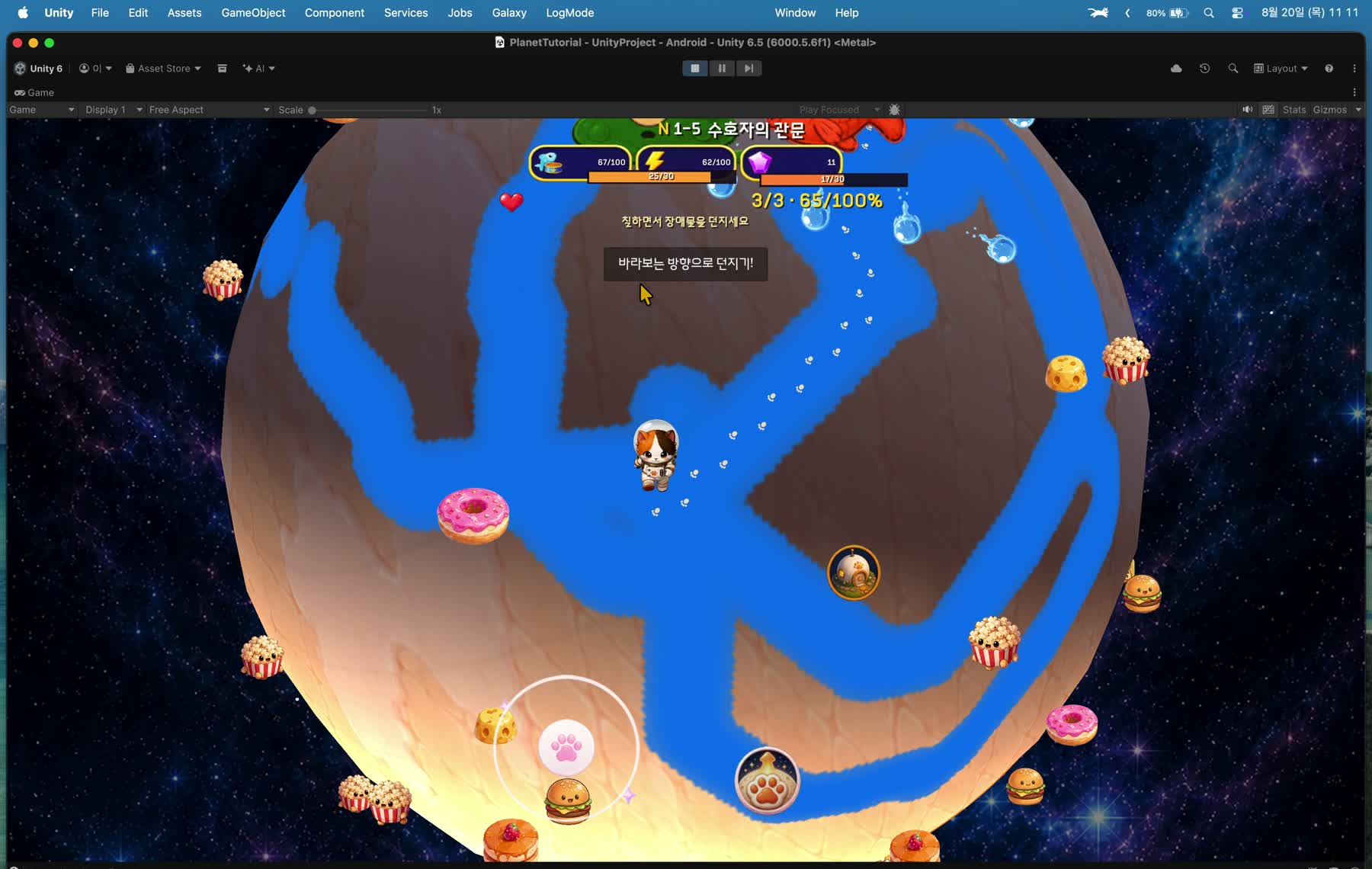
Actually playing the build to check, not just reading the report that says it is done.
The day I heard “fixed” nine times
On August 25, 2026, I heard that word nine times in one day. A monster with the wrong elemental type showing up on the wrong stage. Monsters clustering into one type when they should be mixed. The wrong background music playing during a scene in space. Different bugs, same word attached to all of them.
Here is one of them, in detail, because it is the clearest example.
My game has day and night stages, and each stage only allows monsters that match its time of day. Fire-type monsters are not supposed to appear on a night stage. But there it was: a night icon in the top corner of the screen, and a fire fox monster standing right below it, exactly where it should not be.
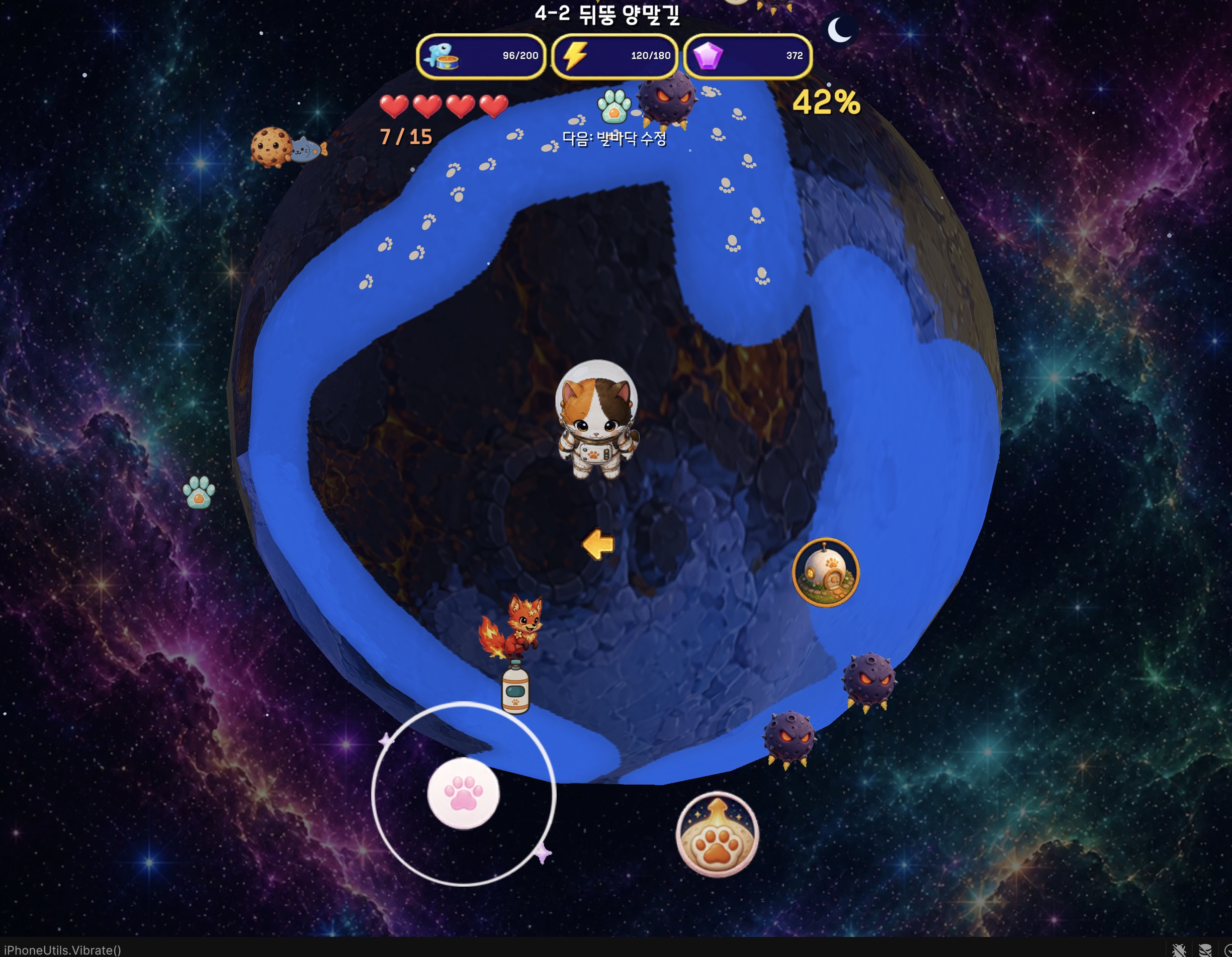
The night stage, wrong monster. A moon icon top-right, a fire-type fox standing in front of it.
I took a screenshot, sent it to the AI, and asked it to fix the mismatch. A little while later: “Fixed.”
The old me would have stopped right there. Word received, box checked, on to the next thing.
What I have learned the hard way — “in the code” and “I saw it” are different claims
Not being able to read code does not mean I cannot check anything. What I cannot do is read whether the code is written correctly. What I can do is turn the game on and look at the screen with my own eyes. Those are two completely different kinds of checking, and only one of them is available to me.
When the AI says “fixed,” it usually means the code has been changed and it has run some kind of check on its own — inside its own head, so to speak, not on the actual running game. This time it told me it had spawned monsters under night conditions twenty-four times in a row and confirmed none of them were fire-type. That is a real check. It is just not the check that matters to me, because I never turned the game on and walked into that stage myself.
I have been burned by exactly this gap before. A while back, monsters and items looked too small on large stages, and I was told that was fixed. Later, when the screen was actually reviewed again, they still looked too small. The code had genuinely changed. Something had genuinely been checked. None of it had produced the result I actually wanted on the actual screen. That is when I made a rule for myself.
I do not say “fixed” until I have turned the game on and looked.
Counting all nine again
I went back through that day’s log and checked all nine items, one at a time. Every single one was in the same state. The AI had changed the code and run its own checks. Not one of them had a checkmark next to “I actually launched the game and saw it work.”
I could have written down “fixed nine things.” Instead I wrote: “AI put the code in. I have not checked yet.” The number of items did not change. What changed is that the sentence now tells the truth.
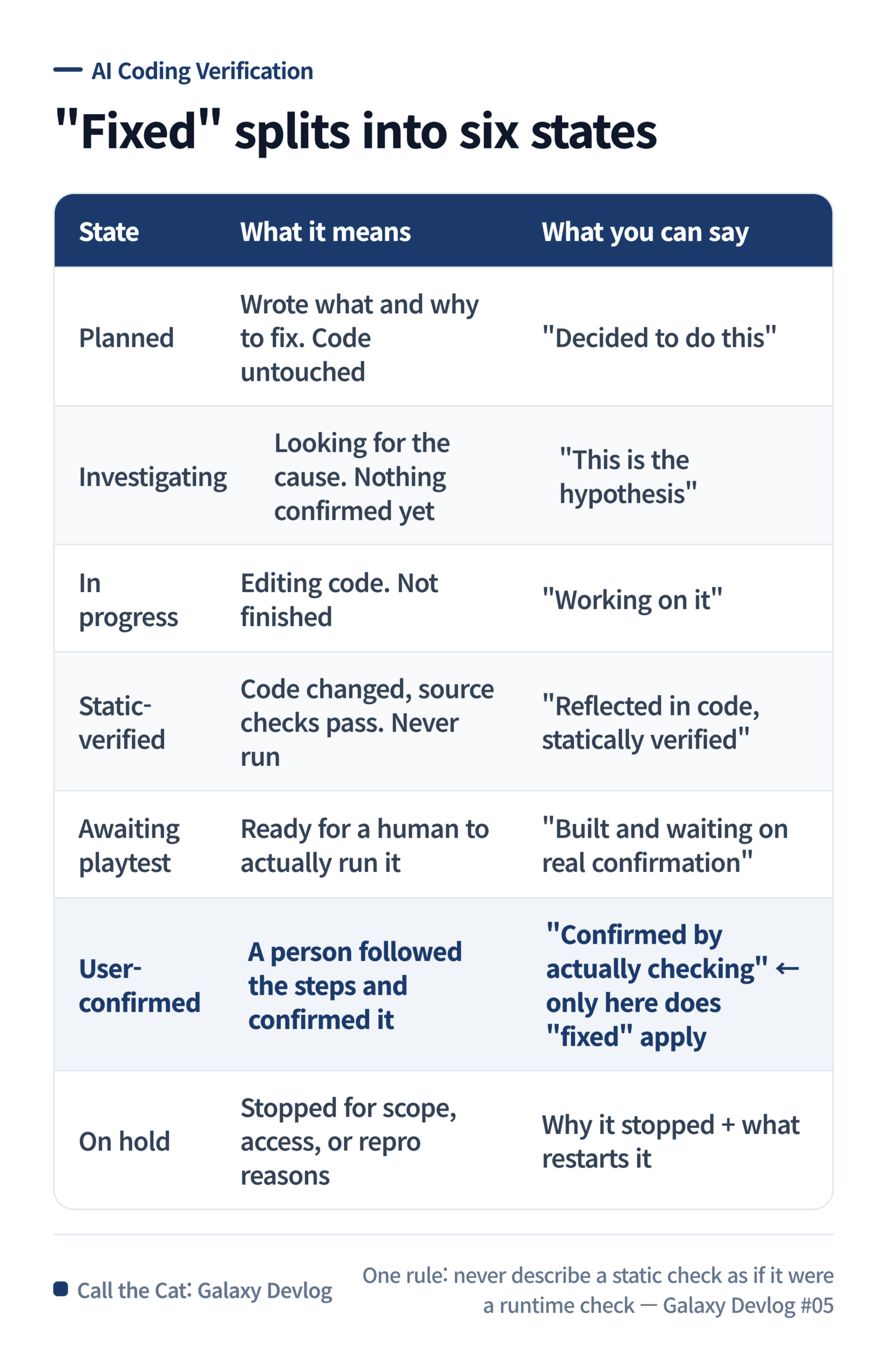
The more detailed version of this we track internally — six states instead of two, for when a bug needs more than “checked or not.”
The one question that works without reading a single line of code
When the AI tells me something is done, I do not ask about the code. I ask this instead:
“Is that something you decided just by reading the code, or is that something I need to actually run and see for myself?”
If the answer is “the code is in, but running it and seeing it is on you,” then from that point on I do not say “fixed.” I say “AI put the code in, I have not checked yet.” Only after I have turned the game on and watched that exact moment happen with my own eyes do I write “confirmed.”
Copy this — it costs nothing and needs no coding knowledge
When AI says “fixed,” “done,” or “resolved”: ask “Did you decide that from the code, or do I need to run it myself and check?”
When AI confirms it only checked the code: write “AI put the code in. I have not checked yet.”
After you have run it yourself and seen it: only now, write “Confirmed.”
This is not specific to game development or to Unity. It works for anything you are directing an AI to build, as long as the result is something you can eventually see or use with your own eyes — you do not need to read a single line of the work behind it.
Where this leaves things
This is not about trusting AI less. I am going to keep handing it code to write; that part is not changing. What changed is that I stopped treating “the code is in” and “I have confirmed it” as the same sentence.
All nine items from August 25 had made it through the first half of that process and stopped there. The AI had done its part. What was left was something I could do without reading a single line of code: turn the game on, and look.
Solo dev of Call the Cat, shipped after 178 days
on Google Play
and Steam.
Now building the sequel, Call the Cat: Galaxy, in public.